


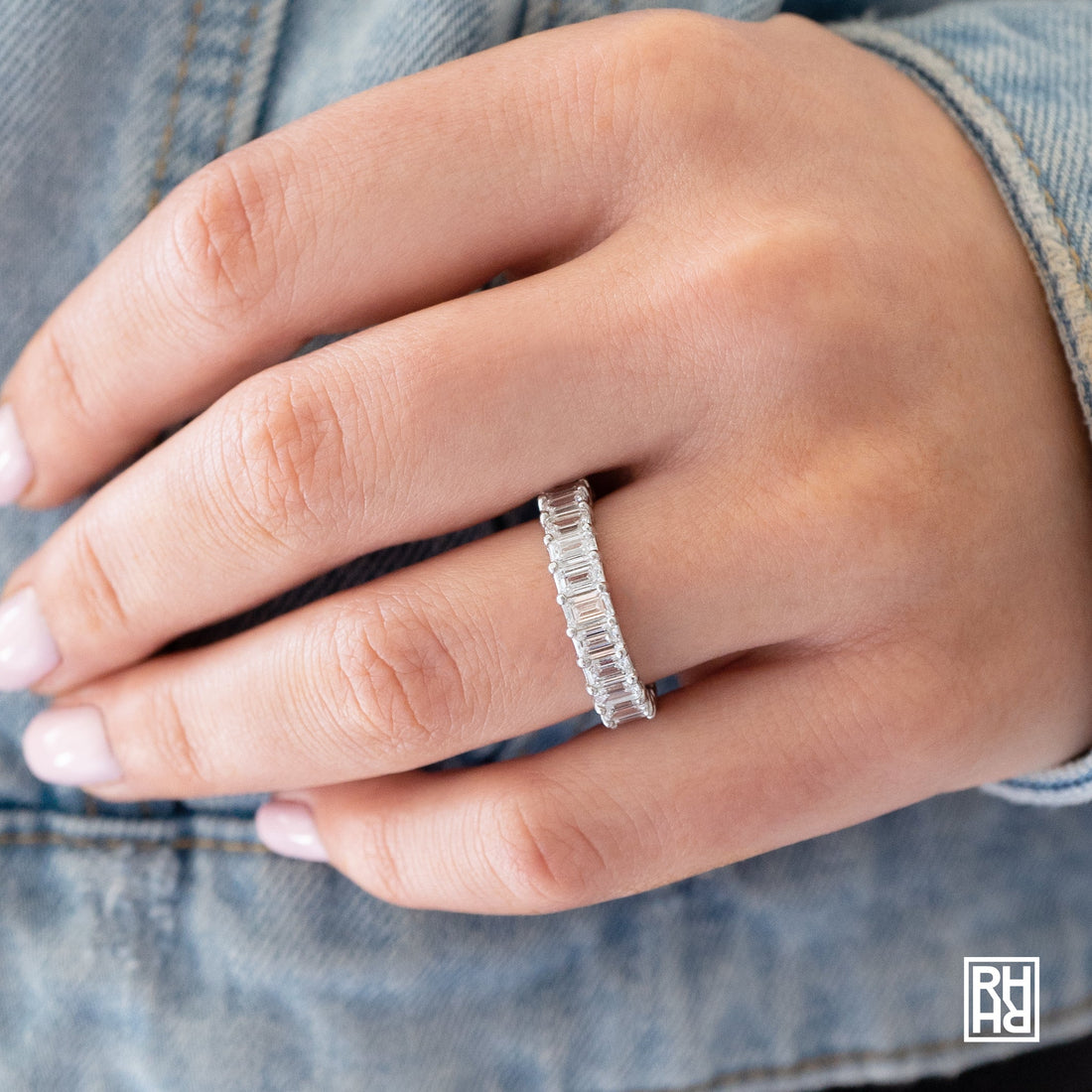
Engagement Rings vs. Wedding Bands: Planning the Perfect Set
When it comes to symbolizing your love, there are two star players: the engagement ring and the wedding band. These rings are closely related – often worn together – but they serve different purposes in your journey from “Yes!” to “I do.” Understanding their differences, how they work as a pair, and how to choose each thoughtfully will ensure you end up with a complementary set you’ll cherish forever.
In this guide, we’ll clarify what each ring represents, tackle common questions (like do you really need both?), and share tips on coordinating the style of your engagement ring and wedding band to create a perfect duo.
Engagement Ring vs. Wedding Band: What’s the Difference?
An engagement ring is the ring given (usually to the bride-to-be) at the time of proposal. It’s often more elaborate, typically featuring a prominent center gemstone (most commonly a diamond). This is the ring that says “We’re engaged!” and it’s usually worn from the moment of proposal onwards.
A wedding band (or wedding ring) is exchanged by both partners during the wedding ceremony itself. Wedding bands tend to be simpler in design – often a plain metal band or a ring with small accent diamonds – and are a symbol of the marriage commitment. Traditionally, the wedding band is worn by both spouses after the wedding, alongside the engagement ring for those who have one.
In short, the engagement ring is about the promise leading up to marriage, and the wedding band is about the actual vows of marriage. One precedes the wedding, the other debuts at the ceremony. Culturally, they developed at different times (the engagement ring concept has been around since at least medieval times for betrothals, whereas the double-ring ceremony with both bride and groom exchanging bands became common in the 20th century).
Design-wise, engagement rings steal the show with that center stone and are often made to be eye-catching, whereas wedding bands are typically more low-profile since they’re worn continuously (and need to be comfortable and practical).
However, modern trends can blur these lines – some wedding bands for brides are quite sparkly (like diamond eternity bands), and some engagement rings for men exist. The key difference lies in when they’re given and what they signify.

Do You Need Both Rings?
While most couples do use both an engagement ring and a wedding band, it’s not a hard requirement – it really comes down to personal preference and cultural norms. Here are a few scenarios:
-
Both Rings (Traditional): One partner proposes with an engagement ring; at the wedding, both partners exchange wedding bands. This is common in the U.S. and many countries. It results in the bride (in a heterosexual couple) wearing both rings together after marriage, and the groom wearing just a band.
-
Single Ring for Both: Some couples decide that one ring will serve as both the engagement and wedding ring. For example, if the bride-to-be isn’t into wearing multiple rings, she might opt for a diamond band that is given at proposal and then used as the wedding ring at the ceremony (just put back on during vows). Or a couple might choose matching rings and use them for the engagement (perhaps both wearing them) and then again as the wedding rings.
-
No Engagement Ring: Occasionally, couples skip the engagement ring altogether for practical or financial reasons, and just exchange bands at the wedding. This might be the case if they preferred to invest in other things or if they mutually agreed a proposal ring wasn’t necessary.
-
No Wedding Band: This is rarer, but some people continue to wear only their engagement ring after marriage and forego a separate band. For instance, if an engagement ring is a substantial band style by itself, they might feel it already looks complete.
There’s no right or wrong answer. It largely depends on what you as a couple value and want to wear. Some people love the tradition and symbolism of two rings (“the more rings the merrier!”), and some favor minimalism (one ring total). Just make sure if you deviate from the both-rings norm, you’re both on the same page to avoid hurt feelings or misunderstandings.
Many jewelers offer bridal sets (matching engagement ring and wedding band together) precisely because most people do go with both. But remember, your marriage, your rules – do what feels right for you.
Buying the Engagement Ring and Wedding Band: Together or Separately?
Buying an engagement ring is usually the first step – often a surprise for one partner. The wedding bands typically come later, sometimes closer to the wedding. But there’s flexibility in how you approach purchasing these rings:
-
Separate Occasions: Traditionally, the proposer picks out (or custom designs) an engagement ring and pops the question. Only after that do you think about wedding bands – maybe shopping for them a few months before the wedding, often together as a couple. This approach allows the engagement ring to shine solo for a while and lets the couple choose bands that go well with it.
-
At the Same Time / Bridal Set: Some couples (especially those who plan the proposal together or who get engaged without a ring and then shop) will choose the engagement ring and matching wedding band at the same time. Jewelers often have matching sets where the band is made to complement the ring. Buying as a set can sometimes save money or at least guarantee the rings match perfectly in style and fit.
-
Engagement Ring Now, Band Later (with forethought): Even if you’re buying the engagement ring solo as a surprise, it’s wise to keep the wedding band in mind. Take note of whether the ring you choose has a matching band design available, or if its shape will require a custom-contoured band. (For example, if you pick a dramatic halo engagement ring that doesn’t sit flush with a straight band, you might eventually need a curved band – some rings have one made to match.)
-
Custom Both Rings: If you’re going custom, you could design the engagement ring first, then go back to the designer for a bespoke band that fits it later. Or design both from scratch as complementary pieces.
There’s no harm in buying at separate times versus together. Just avoid a common pitfall: forgetting to budget for the wedding bands! Couples often allocate a big budget for the engagement ring and then realize later they also need to buy two more rings. Planning ahead (even if loosely) ensures you won’t be caught off guard financially.
Many jewelers, including Rockher, have options to “Build a Set” – you can pick an engagement ring and see recommended matching bands, or vice versa. This can be really helpful if you want to visualize how the two will look together before committing. At Rockher, for example, our online tools can show you a engagement ring style paired with different band styles so you can mix and match virtually before you buy.
Coordinating Styles: Matching Metals and Designs
One big question is how much your engagement ring and wedding band need to match. Here are some aspects to consider:
-
Metal Type and Color: A traditional approach is to have both rings in the same metal and color (e.g., both 18k yellow gold, or both platinum) for a unified look. This is especially true if they’re worn together on one finger. It ensures the rings look like a set – for instance, a platinum band won’t scratch a softer gold ring, and the color tones won’t differ. However, mixing metals is increasingly popular (think a white gold engagement ring with a rose gold band for a trendy contrast). If done intentionally, it can look fantastic. So, matching metals are nice for harmony, but it’s not mandatory – personal style comes first. Just be cautious if you have drastically different metals like a very hard metal paired with a softer one, as wearing them fused might cause extra wear on the softer ring.
-
Style and Era: Some engagement rings have a very distinct style (vintage, modern, art deco, etc.). You can choose a band in keeping with that style for consistency. For example, a vintage filigree engagement ring can pair with a band that also has filigree or milgrain detail. Alternatively, you might go for contrast – a sleek, plain band with a very ornate engagement ring to avoid overdoing it. Neither is wrong; it depends if you want the rings to “mirror” each other or for the band to play a supporting role.
-
Width and Proportion: A delicate one-carat solitaire on a thin 1.8mm band might look best with an equally delicate wedding band (so it doesn’t overpower it). Conversely, if you have a very thick engagement ring band, you’ll need a wedding band of similar heft or it may not even sit flush. The rings should have compatible dimensions so they look like they belong together and feel comfortable.
-
Embellishments: If your engagement ring has diamonds on the shank (like a pavé band), you might love a similarly pavé-set wedding band for a full sparkle effect. Or you might intentionally choose a plain band to let the engagement ring stones stand out. Also consider shapes – a ring with round stones could pair nicely with a band with round stones, whereas a ring with a unique marquise diamond might look cool with a marquise-shaped accent band that echoes that shape.
-
Matching Sets: Jewelry brands often create bridal sets where the band literally interlocks or aligns perfectly with the engagement ring design. These can be beautiful and convenient (no guesswork, and usually flush-fitting). The downside is they’re made for each other, so wearing the band alone might look a bit odd if it has a notch meant for the engagement ring. Still, many love the cohesiveness of a set designed as one.
In the end, balance is what you’re after. The two rings should complement each other, even if they aren’t an identical match. Lay them side by side (or use online previews) to see if any element clashes or if it’s a pleasing combo. If one ring is very elaborate, often a simpler partner works well, and if both are ornate, make sure it’s the look you want (some people adore an all-out glamorous set!).
Remember that these rings will be worn together much of the time, so it’s worth finding a pairing that you find aesthetically satisfying.
To Solder or Not to Solder?
After the wedding, some brides choose to have their engagement ring and wedding band soldered together. This means a jeweler fuses them so they become one double-ring that always aligns perfectly. This can be a practical choice if your rings tend to spin or rub and you want them to stay put as a set.
Pros of Soldering:
-
The rings won’t twist around separately, so the set looks perfectly positioned all the time (great for sets with curved bands or wraps).
-
Soldering can reduce wear on the rings because they won’t rub against each other as much.
-
It can make wearing them more comfortable (no pinching between rings).
-
You essentially treat them as one ring, which simplifies things like removing for cleaning.
Cons of Soldering:
-
You can no longer wear the rings separately. If you planned to sometimes wear just your band (say, for travel or workouts), soldering removes that option.
-
Resizing can be more complicated – both rings have to be done together if your finger size changes.
-
If the symbolism of two distinct rings matters to you, you might not want them physically joined.
Many people opt not to solder and simply wear their rings together without issue. Some use ring guards (little plastic or metal clasps) to keep them together temporarily instead.
If you do choose to solder, any jeweler can typically do it, and it’s reversible (they can separate them if needed down the line, though it may leave tiny marks). It’s usually best to wait a little while after the wedding to be sure you’re happy with the ring fit and combo before soldering.
This aspect is entirely personal preference. There’s no rule that you should or shouldn’t – it’s about what feels best and is most convenient for you in daily life.

How to Wear Them: Ring Order and Placement
Traditionally, once married, the wedding band is worn on the inside (closer to the heart) and the engagement ring is worn above it. So when looking at your left hand, the order from base of finger outward is: wedding band, then engagement ring. This is why some brides switch their engagement ring to the right hand just for the ceremony, so that the groom can easily slide the band onto her left finger first, then she later stacks the engagement ring on top.
However, there’s no legal or strict rule about this. Some people find it more comfortable or aesthetically pleasing to wear them in the reverse order (with the engagement ring first, and the band on the outside). You won’t get struck by lightning for doing so – it’s totally up to you.
A few wearing tips:
-
Welding Set: If your rings are a set that interlock in a certain way, obviously you’ll follow that design’s intended order.
-
Multiple Bands: If you have more than one wedding band (say, you eventually add an anniversary band), you might frame your engagement ring with one band on each side. This symmetrical look is popular for ring stacks.
-
Different Hands: Some women choose to wear the engagement ring on the left and move their wedding band to the right hand. This could be for comfort (maybe the two rings don’t sit well together or cause irritation) or tradition (in some cultures, the wedding ring is worn on the right hand).
-
During Activities: Many people wear their wedding band alone day-to-day, especially if it’s low profile, and keep the engagement ring in a safe place or wear it only for going out or work (this is common for those with very large or valuable engagement rings). That’s totally fine – the engagement ring doesn’t always have to be glued to your hand. The band can be your main daily symbol if you prefer.
At the end of the day, how you wear your rings is a personal comfort and style decision. Play around after the wedding with what feels best. As long as you don’t lose them, you’re doing it right!
Breaking “Rules” and Making Your Own Traditions
There are plenty of old-school “rules” about engagement and wedding rings – but 2025 couples are rewriting them. Let’s debunk a few and give you the freedom to do what suits you:
-
“They must be the same metal and style.” Not anymore! While matching can look elegant, mixed-metal and eclectic pairings are very much in vogue. For example, a rose gold vintage-style engagement ring can absolutely pair with a white gold minimalist band if that’s the look you love. Contrasting styles can make each ring stand out more.
-
“The wedding band should be simpler and never overshadow the engagement ring.” Traditionally, yes, people kept the band plain. But many modern brides opt for an eternity band full of diamonds next to their solitaire – and it looks stunning. As long as the two rings complement each other, it’s fine if the band is equally or even more dazzling. It’s about your personal sparkle preference.
-
“You have to spend X on rings” or any budget rule: Some say you should put more money into the engagement ring, and wedding bands should be inexpensive. In reality, allocate your budget across the two (or three) rings however makes sense for you. Some couples choose a moderate engagement ring and invest in diamond bands for both, balancing the total. Others go all-out on the engagement ring and keep bands super simple. There’s even a trend of upgrading bands on anniversaries. There’s no one-size-fits-all – financially, do what works with your priorities.
-
“The engagement ring is for her, the band is for him.” Nope. Anyone can wear engagement rings; anyone can wear wedding bands. We’re seeing more women give their partner an engagement band, and we’re seeing more men wearing one, or both partners exchanging rings at the proposal. Same-sex couples have long done whatever fits them, and heterosexual couples are catching on that they can mix it up too. What matters is that you both feel included and happy with whatever rings you choose to symbolize your commitment.
In essence, the “rules” are just old traditions. Feel free to adopt the ones you like and toss the rest. You want your rings to feel meaningful and authentic to you – not just a cookie-cutter expectation.

Making Them Both Special
Finally, a few tips on ensuring both your engagement ring and wedding band feel special and yours:
-
Personalization: We mentioned engraving in previous sections – consider adding a personal engraving to each ring (perhaps something different on each, or a continuation of a phrase between the two). It’s a lovely way to link them. For example, the engagement ring could say “Forever” and the wedding band “And Always” – individually meaningful, together complete.
-
Ceremony Moment: During your wedding ceremony, think about how you want to handle the engagement ring. Some brides keep it on (and the groom slips the band on the same finger above it, which can be a bit awkward but doable). Others move it beforehand. A sweet touch is having the engagement ring switched to the right hand and then after the band is on, the groom can gently place the engagement ring back over the band – kind of like “sealing” both on the finger. Do whatever feels right, but having a plan will make that moment smooth.
-
After the Wedding: Some people get their engagement ring cleaned or even replated (if white gold) just before the wedding so it’s as shiny as the new band. Then both rings start fresh on day one of marriage. You can also get them appraised and insured together at this point if you haven’t already – an important step for peace of mind.
-
Milestone Ring: Some couples plan from the start that the wedding band will be the one they splurge on or give extra significance to (especially if the proposal ring was a placeholder or a simpler piece). There’s no rule that says the engagement ring has to be the “star” – for some, the band carries even more emotional weight because it’s directly tied to the vows. So if you want to, for example, design custom wedding bands with motifs that tell your love story, by all means let that aspect shine.
At the end of this journey, you’ll have not one but two very important rings that hopefully complement each other and remind you of distinct chapters – the excitement of your engagement and the depth of your commitment at marriage. Taken together, they form a set that tells your unique story.
Conclusion
Your engagement ring and wedding band are a team – each beautiful on its own, but even more meaningful together. Planning how they’ll complement each other is an enjoyable part of the wedding process. As you’ve seen, there’s plenty to consider: tradition vs. personal preference, matching vs. mixing, and how to honor the significance of both rings.
The key takeaways? Understand the purpose of each ring, but don’t be bound by convention when it comes to style. Communicate with your partner about what you both want. And most importantly, choose what makes you happy every time you look at your hand.
Whether you end up with a coordinated dazzling set or a quirky mix-and-match duo, if it reflects your love and personalities, it’s perfect. Both rings symbolize a journey – one started with a promise and one made official with vows. However you choose to wear them, they’re yours to define.
In the years to come, you might add anniversary bands or make changes, and that’s fine too – your ring story can evolve with your marriage. What matters now is that you enter marriage with rings that you’ll cherish as much as you do each other.
Here’s to finding the perfect harmony between your engagement ring and wedding band – and to a lifetime of wearing them in good health and joy. Congrats on your engagement, and best wishes for the beautiful moments ahead!
